Memphis Patterns: A Practical Guide to Bold, Black Geometric Design Resources
Memphis Patterns refer to a distinct visual language rooted in the 1980s Memphis Group movement—characterized by asymmetry, clashing colors, and playful geometry. Today’s Memphis pattern reinterpretations often simplify that exuberance into focused, high-contrast palettes—especially black-on-white or black-on-transparent variants. The Black vector Memphis mosaic pattern set you’re evaluating fits squarely within this modern adaptation: a curated collection of flat, geometric motifs designed for clarity, scalability, and immediate usability across print and digital media.
What Makes This Memphis Pattern Set Distinct?
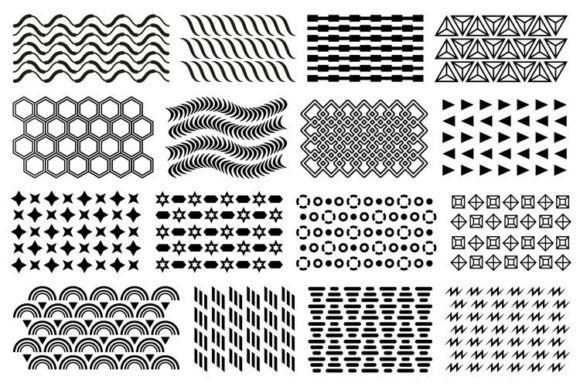
This set stands out not because it reinvents the Memphis aesthetic—but because it refines it for contemporary production needs. Unlike generative or hand-drawn Memphis-style assets, these are precision-crafted vector elements. Each of the 16 patterns is built from clean lines, consistent stroke weights, and deliberate negative space—optimized for legibility at small sizes (e.g., business card borders) and impact at large scales (e.g., wall-sized event backdrops).
The emphasis on black flat geometric design elements serves functional goals: high contrast ensures readability over photos or textured backgrounds; monochrome neutrality avoids color-clashing in brand-aligned layouts; and the absence of gradients or textures preserves crispness when scaled or printed. That practicality extends to format support: JPG (for quick placement in non-design apps), PNG with transparent background (ideal for layering in presentations or web mockups), SVG (responsive web use), AI and EPS (full editability in professional vector environments). All files ship at 300 ppi—meeting standard print requirements without upsampling guesswork.
How It Compares to Broader Memphis-Inspired Options
Not all Memphis-style resources serve the same purpose. Some collections prioritize maximalist color combinations or organic distortion—valuable for editorial illustration or mood boards, but less suited for branded collateral where consistency matters. Others offer single-pattern downloads or low-resolution raster files, limiting flexibility in layout iteration or output quality.
This set occupies a middle ground: more structured than experimental Memphis art packs, yet more expressive than generic geometric tile libraries. Compared to algorithmically generated “Memphis-style” patterns (often found in online design tools), these are hand-tuned—each shape placement, spacing, and repetition interval reflects intentional rhythm rather than procedural randomness. That difference becomes visible when aligning patterns across multiple brochure panels or matching a flyer border to a social media banner.
Strengths and Real-World Fit
The primary strength lies in predictability and compatibility. Because every file is delivered in multiple formats—including editable vector sources—you retain control whether you’re adjusting tile spacing in Illustrator, exporting a web-safe SVG for a landing page, or dropping a PNG into Canva for a quick team announcement.
Consider these realistic use cases:
- Printed marketing materials: Brochures, flyers, and postcards benefit from the 300 ppi JPG and PNG files—no pixelation when printed at actual size. The black-on-white contrast ensures ink coverage remains economical while retaining visual weight.
- Digital presentations: Presenters using PowerPoint or Google Slides can apply PNGs with transparency as subtle slide backgrounds—adding texture without competing with text or data visuals.
- Branded environmental graphics: Trade show booths or retail signage often require large-format prints. SVG and AI files scale infinitely, so a 24” × 36” poster uses the same asset as a 4’ × 8’ wall decal—no re-rasterization needed.
- UI and web accents: While full Memphis aesthetics rarely suit interface design, individual motifs (e.g., corner brackets or section dividers) extracted from these patterns work well as lightweight, scalable SVG icons or decorative elements.
Tradeoffs and Situational Limitations
No resource excels in every context—and understanding where this set has boundaries helps avoid misapplication. First, it is intentionally monochromatic. If your project requires vibrant Memphis energy—think coral zigzags against teal grids—this isn’t the solution. Similarly, while the 16 patterns offer variety (stripes, chevrons, interlocking polygons, fractured grids), they don’t include organic flourishes, hand-drawn imperfections, or layered textures common in illustrative Memphis interpretations. That’s by design: it trades expressive range for technical reliability.
Another consideration is licensing scope. These files are intended for end-product use—not resale as standalone pattern assets. So if you’re building a design template marketplace or selling customizable stationery kits, verify usage rights before integrating them into derivative products.
When to Choose This Over Alternatives
This Memphis pattern set shines when your priority is execution speed without compromise on quality. You’re likely evaluating it alongside:
- Free pattern libraries: Many offer Memphis-inspired tiles, but often at 72 ppi, without vector options, or with inconsistent spacing. Replacing one low-res tile mid-project means reworking alignment, shadows, or exports—time better spent refining messaging or layout.
- Custom illustration: Commissioning bespoke Memphis motifs delivers uniqueness but carries cost, timeline, and revision overhead. For time-sensitive campaigns (e.g., conference promotions or seasonal sales), off-the-shelf precision saves weeks.
- Design tool plugins or generators: These provide instant variation but rarely guarantee output consistency across devices or export fidelity. A generated pattern may look sharp on screen but blur when printed—or fail to tile seamlessly across bleed areas.
If your workflow involves tight deadlines, multi-channel output (print + web + presentation), or collaboration across designers and non-designers (e.g., marketing teams using Canva), the included format diversity and resolution assurance reduce friction significantly.
When Another Option Might Be Better
That said, this set isn’t universal. If your project demands:
- Full-color Memphis energy: Look for curated color-separated vector packs or hire an illustrator to adapt these black motifs into your brand palette.
- Animated or interactive patterns: SVG files here are static. For motion-based applications (e.g., animated website backgrounds), you’d need additional development or animation software expertise.
- Highly contextual or narrative patterns: Memphis patterns excel at abstraction—not storytelling. For infographics or educational materials requiring symbolic meaning (e.g., a “growth” motif), custom iconography may communicate more directly.
- Mass customization at scale: If you’re generating thousands of unique variations (e.g., personalized product packaging), parametric design tools or scripting may offer more automation than static vector files.
Making a Practical Decision
Evaluating Memphis pattern resources isn’t about finding the “most Memphis”—it’s about matching aesthetic intent with technical execution. Ask yourself:
- What’s my primary output medium? (Print, web, presentation, or mixed?)
- Do I need full editability—or is drag-and-drop placement sufficient?
- How much time can I allocate to asset preparation versus content development?
- Does consistency across touchpoints matter more than stylistic novelty?
If the answer leans toward reliability, cross-format readiness, and immediate integration—especially for black vector Memphis mosaic pattern use in posters, brochures, and flyers—this set aligns closely with those needs. Its value isn’t in exclusivity, but in removing common production bottlenecks: no hunting for matching resolutions, no wrestling with raster artifacts, no guessing whether a pattern will tile cleanly at 200% zoom.
Ultimately, Memphis Patterns remain relevant not because they’re nostalgic—but because their underlying principles—clarity through contrast, structure through geometry, and personality through rhythm—translate reliably across decades and technologies. This collection honors that legacy by prioritizing utility without diluting its visual character.