Lemon Patterns: Fresh, Versatile Design Assets for Modern Creators
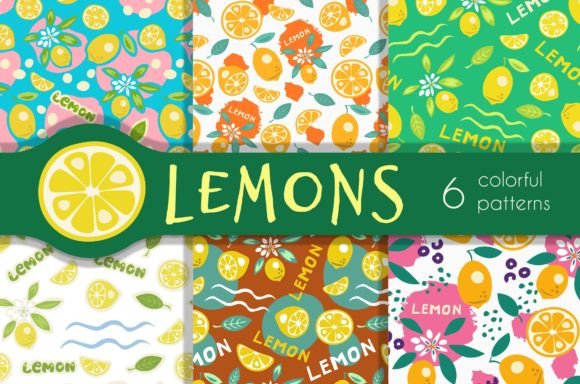
There’s a quiet shift happening across creative workflows — one where authenticity meets efficiency, and handmade warmth coexists with digital precision. Lemon Patterns embodies that shift. It’s not just another clipart pack or generic texture set. It’s a curated collection of six seamless lemon-themed patterns, delivered in both EPS (vector) and high-resolution JPG formats — 4000 × 4000 pixels at 300 dpi. That means crisp scaling for print, pixel-perfect clarity for web, and true flexibility across physical and digital applications.
Why Lemon Patterns Fits Today’s Creative Reality
Designers, small business owners, educators, and hobbyists no longer choose between “handcrafted charm” and “professional polish.” They expect both — simultaneously. Lemon Patterns bridges that gap. Its citrus motifs are stylized but not cartoonish; vibrant but not overwhelming; playful yet refined enough for branding or editorial use. This balance reflects broader trends: the rise of intentional minimalism, the demand for cohesive visual systems, and the growing preference for assets that work *across contexts* — not just one use case.
Consider how people create today: A wedding planner designs invitations in Canva, then adapts the same pattern for thank-you cards, digital RSVP pages, and even custom napkin prints. A stationery maker uses one Lemon Pattern as background for printable labels, then scales it down for social media banners. A blogger selects a subtle variant as a blog background — legible behind text, distinctive without distraction. These aren’t hypotheticals. They’re everyday workflows made smoother because the asset is resolution-agnostic, format-flexible, and stylistically versatile.
From Trend to Tool: How Citrus Motifs Evolved Beyond Summer Decor
Lemons used to signal “bright summer party” — and they still do. But their symbolism has deepened. In design psychology, yellow and citrus evoke clarity, energy, and approachability — qualities increasingly valued in brand identities, educational materials, and wellness-focused businesses. Unlike trend-driven graphics that age quickly, Lemon Patterns avoids cliché through thoughtful composition: balanced negative space, restrained color palettes (often monochrome or muted pastel variations), and organic line work that feels hand-drawn but digitally precise.
This evolution mirrors how visual language functions now. People don’t just consume design — they remix it. A café owner might layer a Lemon Pattern over a photo of their latte art for Instagram Stories. A teacher could print a simplified version on cardstock for classroom reward stickers. A packaging designer might tile one pattern at 15% opacity behind product copy to add texture without competing with typography. The lemon motif becomes a flexible visual anchor — familiar enough to feel welcoming, distinctive enough to support identity.
Practical Flexibility Across Real-World Uses
The value of Lemon Patterns isn’t theoretical. It lives in execution — and the collection’s technical specs directly enable real-world adaptability:
- Invitations & greeting cards: The 300 dpi JPG ensures sharp printing on premium cardstock, while EPS allows effortless resizing in Illustrator for foil-stamped details or die-cut edges.
- Website and blog backgrounds: At 4000 × 4000 px, patterns tile cleanly across desktop and tablet views without visible repetition — critical for maintaining professionalism on responsive layouts.
- Wrapping paper and packaging: Seamless tiling eliminates visible seams when printed on rolls or folded boxes. Designers can adjust scale in seconds to suit small gift tags or large shipping boxes.
- Handmade crafts: Scrapbookers and decoupage artists appreciate the clean edges and consistent contrast — no blurry halos or compression artifacts when printed on home inkjets or laser printers.
- Stationery and business cards: Subtle patterns add tactile sophistication without sacrificing readability. One variant works equally well as a full-bleed background or a delicate border element.
- Home decor: From printable wall art to fabric transfer templates, the resolution supports scaling up for framed prints or down for embroidery guides — all from the same source file.
What Changes When You Choose Purpose-Built Assets
Many creators start projects with free downloads or low-res resources — only to hit friction later: pixelation when enlarging, mismatched colors across formats, or licensing limits that block commercial use. Lemon Patterns removes those bottlenecks upfront. Because it includes both EPS and JPG, users aren’t forced into a single software ecosystem. Vector users get infinite scalability; raster users get immediate compatibility with Photoshop, Canva, Affinity Photo, or even PowerPoint.
That dual-format approach reflects how professionals actually work today — fluidly switching between tools based on task, not loyalty. A marketer might build a social media carousel in Canva using the JPG, then hand off the EPS to a print vendor for branded swag. A freelance designer might embed the vector into an InDesign layout for a client’s annual report, then export a cropped section as a PNG for their website’s favicon generator.
Thoughtful Design Meets Everyday Practicality
Lemon Patterns doesn’t chase virality or algorithmic appeal. Instead, it focuses on what creators consistently need: reliability, clarity, and quiet versatility. There’s no learning curve — just drag, drop, scale, and adapt. That simplicity is intentional. Time saved on troubleshooting assets is time invested in storytelling, strategy, or craft.
For example, a small-batch soap maker launching a new “Citrus Grove” line can use one Lemon Pattern across multiple touchpoints in under an hour: a tiled background for product labels, a scaled-down repeat for tissue paper inserts, and a cropped detail as a watermark on Instagram posts. No re-coloring, no tracing, no font matching — just consistency, built in.
Who Benefits Most — and Why It’s Not Just About “Lemons”
Yes, the theme is citrus. But the utility extends far beyond literal interpretation. Educators use the clean geometry of the patterns for math visuals or classroom calendars. Therapists incorporate bright, uplifting motifs into printable worksheets for mood tracking. Developers building landing pages for food-related SaaS tools use the patterns as subtle UI textures behind call-to-action sections — adding warmth without compromising speed or accessibility.
What unites these users isn’t their industry — it’s their need for assets that are:
- Technically sound: Print-ready resolution, seamless tiling, open-format compatibility.
- Stylistically neutral enough to adapt: Not so specific it limits application, not so generic it fades into background noise.
- Ethically straightforward: Clear usage rights, no hidden subscriptions or attribution requirements.
Lemon Patterns meets each criterion without compromise. It doesn’t ask users to bend their process to fit the asset — it bends to theirs.
A Resource That Grows With Your Workflow
Creative needs evolve. A blogger who starts with simple blog backgrounds may later launch an Etsy shop for printable planners — requiring the same pattern in new configurations. A freelancer taking on more packaging clients discovers the same Lemon Pattern works beautifully on kraft paper bags and glossy mailers. Because the files are high-resolution and format-diverse, they don’t become obsolete with growth. They scale — literally and functionally.
That longevity matters. In a landscape saturated with disposable digital goods, Lemon Patterns offers continuity. It’s not a flash-in-the-pan trend piece. It’s infrastructure — quiet, reliable, and ready when you are.