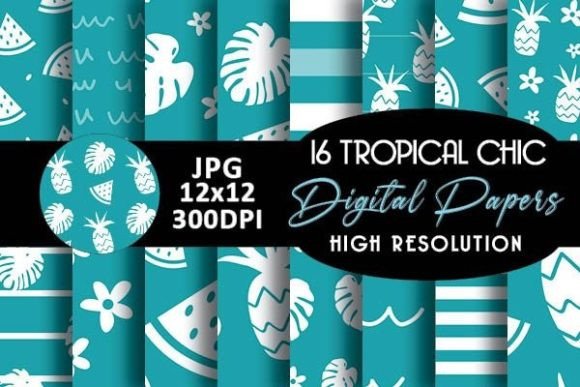
Mint Chic Tropical Digital Patterns: A Versatile Design Resource for Modern Creative Workflows
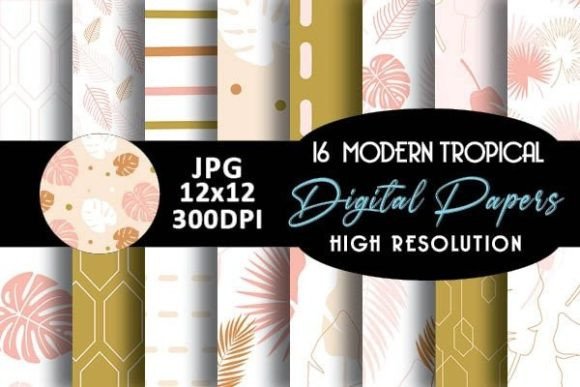
Designers, educators, small business owners, and craft enthusiasts increasingly rely on high-quality digital assets to streamline production while maintaining visual distinction. Among the most adaptable resources in this space are Mint Chic Tropical Digital Patterns — a curated collection of 16 Chic Tropical digital paper backgrounds that balance freshness, sophistication, and practical utility. Unlike generic tropical motifs saturated with oversaturated oranges or clichéd palm silhouettes, this set introduces a refined palette anchored by mint green, soft coral, ivory, seafoam, and muted teals. The result is a cohesive yet dynamic library designed not just for aesthetics, but for real-world adaptability across media, scale, and audience.
What Makes These Patterns Distinctive — Beyond Aesthetic Appeal
The defining strength of these 16 Chic Tropical digital papers lies in their intentional restraint and layered composition. Each background avoids flat repetition; instead, they integrate subtle texture overlays — think fine linen grain, gentle watercolor bleed, or barely-there halftone dots — that add tactility even in digital form. This nuance matters when scaling assets for print (e.g., large-format event backdrops) or screen (e.g., webinar slide decks), where overly smooth patterns can appear artificial or visually fatiguing.
Moreover, the mint-centric foundation provides exceptional versatility. Mint green functions as both a calming neutral and a vibrant accent — it harmonizes with warm tones like terracotta and sand without clashing, complements cool palettes like slate gray and dove blue, and maintains legibility behind light or dark typography. This chromatic flexibility means users aren’t forced into rigid color schemes. A wedding planner might pair Paper #7 (a delicate monoline fern motif on mint-linen) with gold foil text for formal invitations, while a science educator could use Paper #12 (a geometric leaf lattice with soft shadowing) as a background for an ecology-themed classroom handout — same asset, divergent contexts.
Practical Applications Across Diverse User Groups
The utility of Mint Chic Tropical Digital Patterns emerges most clearly when mapped to actual workflows rather than generic categories. Below are representative use cases grounded in real creative constraints and goals:
- Small Business Branding & Marketing: Local cafes, boutiques, or wellness studios often lack dedicated design staff but need consistent, on-brand visuals. These papers serve as ready-made templates for social media banners (Instagram Story frames, Pinterest pins), email newsletter headers, or printable promo cards — all editable in Canva, Adobe Express, or Affinity Designer without requiring advanced layer masking skills.
- Educational Materials Development: Teachers and curriculum designers frequently create custom worksheets, flashcards, or presentation slides. Papers with low-contrast, open-space layouts (e.g., Paper #3 — a sparse monstera outline on airy ivory) provide breathing room for text-heavy content while subtly reinforcing thematic units like botany, geography, or sustainability.
- DIY Craft & Scrapbooking Projects: Unlike mass-produced physical paper pads, digital versions eliminate shipping delays and inventory concerns. Users can print specific sheets on demand — matte cardstock for greeting cards, glossy photo paper for framed art prints, or kraft paper for eco-conscious packaging liners — adjusting DPI and bleed settings per output need.
- Event Planning & Personal Celebrations: From baby showers to milestone birthdays, personalization drives engagement. Because all 16 patterns are delivered as high-resolution PNG and JPEG files (300 DPI, 12"x12" standard size), they integrate seamlessly into invitation suites — serving as full-page backgrounds, border elements, or layered under transparent SVG clipart for depth.
- Product Packaging Mockups & Prototyping: Entrepreneurs developing physical goods (candles, stationery, skincare) use these patterns to generate realistic mockups in tools like Photoshop or Figma. The consistent scale and resolution mean accurate representation of how a label or wrap design interacts with surface texture — critical before committing to print runs.
Technical Considerations for Optimal Use
While accessibility and ease-of-use are central to the design philosophy, thoughtful implementation requires attention to technical detail. First, file format selection matters: PNGs preserve transparency for overlay work (e.g., placing text or icons over patterned layers), whereas JPEGs offer smaller file sizes ideal for web use where transparency isn’t needed. All files are RGB-mode optimized for screen viewing and CMYK-ready for professional printing — no color-shifting surprises during press runs.
Resolution independence is another key advantage. Though delivered at 12"x12", the vector-friendly nature of many motifs (achieved through clean paths and scalable raster rendering) allows safe enlargement up to 24"x24" for wall decals or fabric printing without pixelation. Conversely, shrinking patterns for mobile UI elements (e.g., app splash screens or notification banners) retains clarity due to anti-aliased edges and balanced negative space.
Importantly, these patterns avoid problematic design pitfalls common in tropical-themed assets: no culturally appropriative iconography, no overused clichés like flamingos or tiki masks, and no reliance on stereotypical “exotic” tropes. Instead, botanical references are regionally agnostic (ferns, monstera, banana leaves, abstract fronds) and rendered with botanical accuracy — making them appropriate for global audiences and inclusive educational contexts.
Integration Into Existing Creative Ecosystems
One frequent concern among non-design professionals is compatibility. These 16 Chic Tropical digital papers require no proprietary software. They function natively in free tools (Google Slides, Canva, Photopea), mid-tier applications (Affinity Suite, CorelDRAW), and industry-standard platforms (Adobe Photoshop, Illustrator, InDesign). For users working within collaborative environments — say, a marketing team using Figma or a school district’s shared Google Drive — the files behave predictably: drag-and-drop placement, standard layer blending modes (multiply, overlay), and straightforward opacity adjustments.
For developers or educators building interactive learning modules, the patterns also support HTML/CSS integration. By exporting a pattern as a tiled background image (background-repeat: repeat;) or using CSS background-image with background-size control, they enhance web-based projects without bloating page weight — especially when compressed via modern formats like WebP.
Long-Term Value and Adaptability
Digital assets depreciate quickly if tied too tightly to fleeting trends. What ensures longevity for Mint Chic Tropical Digital Patterns is their dual grounding in timeless color theory and contemporary minimalism. Mint green has cycled through design eras — from mid-century modern interiors to 2020s wellness branding — retaining associations with freshness, balance, and calm. Paired with tropical forms stripped of kitsch, the collection avoids trend exhaustion.
This durability translates directly to cost efficiency. A single purchase replaces the need to license multiple narrow-use assets (e.g., one pack for invitations, another for social media, a third for print). It also reduces cognitive load: instead of searching across stock sites for “tropical background,” “mint green paper,” or “subtle leaf pattern,” users have a unified, quality-controlled source. That consistency builds brand coherence faster — whether you’re designing a series of quarterly reports or launching a seasonal product line.
Real-World Observations From Early Adopters
Feedback from educators using these patterns in hybrid classrooms highlights unexpected benefits: students report higher engagement with visually calm materials during prolonged screen time, and printed handouts show improved readability compared to high-contrast alternatives. Small business owners note reduced revision cycles — clients more readily approve designs built on these papers because the underlying aesthetic feels both distinctive and trustworthy.
Notably, several freelance designers have repurposed individual motifs as base layers for custom SVG icon sets (e.g., extracting a single frond shape to build a cohesive “eco-services” icon family), demonstrating how the collection serves as both finished product and raw material — a rare duality in digital paper libraries.
Strategic Implementation Tips
To maximize impact, consider these evidence-informed practices:
- Start with purpose, not pattern: Before selecting a paper, define the primary action (e.g., “guide attention to a call-to-action button”) or emotional tone (“convey relaxed expertise”). Let that dictate contrast level and motif density — busy patterns suit decorative borders; sparse ones anchor information-dense layouts.
- Test legibility rigorously: Overlay sample body text at 12pt and 16pt sizes. If word spacing or character recognition suffers, adjust text color (not just brightness — consider hue shifts, e.g., charcoal gray instead of black on mint) or apply a subtle semi-transparent overlay.
- Leverage metadata: Rename downloaded files descriptively (e.g., “mint-chic-tropical-paper-09-fern-lattice-300dpi.png”) to accelerate future retrieval — especially valuable when managing dozens of asset libraries across client projects.
- Respect licensing boundaries: While the collection permits commercial use, resale of unaltered papers as standalone products (e.g., selling the files on Etsy) is prohibited. However, incorporating them into original designs — such as a printable planner or branded workshop workbook — is fully supported.
Ultimately, Mint Chic Tropical Digital Patterns succeed not by chasing novelty, but by solving persistent creative challenges: reducing decision fatigue, ensuring cross-platform reliability, and delivering aesthetic cohesion without sacrificing functionality. Their 16 distinct papers operate less as decorative flourishes and more as foundational infrastructure — quiet enablers of clarity, connection, and confident expression across disciplines and devices.