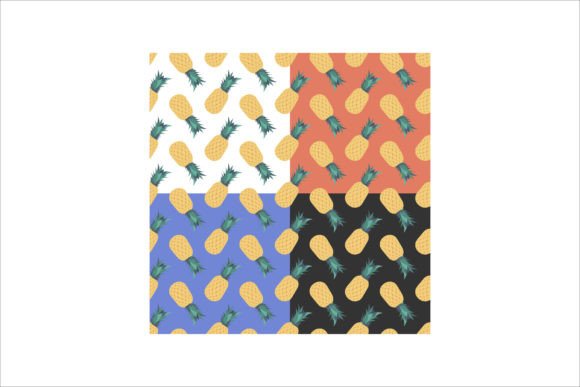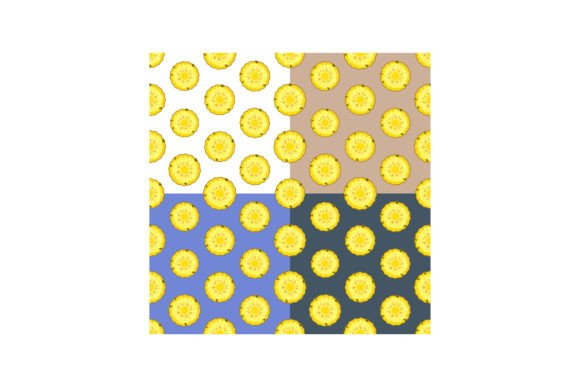
Set of Seamless Patterns with Pineapple: Design Versatility Meets Tropical Authenticity
Seamless patterns—repeating graphic elements that tile infinitely without visible edges—are foundational in visual communication, textile design, and digital product development. Among the most enduring and adaptable motifs are those rooted in botanical illustration and tropical iconography. The Set of Seamless Patterns with Pineapple stands out not merely as decorative filler but as a functional design system grounded in cultural resonance, botanical accuracy, and technical precision. When paired with its circular variant—the Set of seamless patterns with pineapple circle—this collection offers layered compositional flexibility ideal for both analog and digital workflows.
Why Pineapple? Beyond Cliché to Contextual Meaning
The pineapple carries layered significance across geographies and disciplines. Historically, it symbolized hospitality in colonial-era Europe; today, it evokes warmth, vibrancy, and ecological richness—especially in regions where harvesting tropical fruits remains central to agrarian economies and cultural identity. Unlike generic fruit motifs, pineapple illustrations demand attention to anatomical fidelity: the spiky crown, hexagonal fruitlet arrangement, and textured rind all contribute to visual recognition and authenticity. In vector-based seamless patterns, these details translate into scalable, resolution-independent assets that retain clarity at any size—from embroidery stitch files to billboard-scale murals.
This specificity matters in practice. A designer selecting a pineapple motif for a sustainable fashion line isn’t choosing “just a fruit.” They’re signaling alignment with sun-drenched ecosystems, artisanal harvesting traditions, and responsible material sourcing. Likewise, educators using these patterns in curriculum materials on botany or global agriculture gain an accurate, engaging visual anchor—one that avoids cartoonish simplification while remaining accessible to diverse age groups and learning styles.
Technical Distinctions: Seamless vs. Circular Variants
The Set of Seamless Patterns with Pineapple and the Set of seamless patterns with pineapple circle serve complementary but distinct roles in design execution:
- Standard seamless variants use rectangular or square tile boundaries optimized for continuous tiling across surfaces—ideal for fabric printing, wallpaper, web backgrounds, and packaging repeats. Their construction prioritizes edge-matching: every element crossing the right edge reappears identically on the left, and top-to-bottom continuity ensures uniform coverage without seams or gaps.
- Pineapple circle variants, by contrast, center the motif within a radial framework. These are not merely cropped circles—they’re designed with rotational symmetry and balanced negative space, making them suitable for badges, labels, textile medallions, ceramic decals, and UI icons. The circular format inherently suggests unity, focus, and completion—qualities leveraged effectively in branding for wellness products, eco-tourism initiatives, or culinary education platforms.
Both formats exist in vector format, meaning they’re built with Bézier curves rather than pixels. This enables infinite scaling without quality loss, precise color separation for screen printing, and effortless adaptation to Pantone libraries or CMYK workflows. Vector also supports parametric editing: designers can adjust stroke weight, recolor individual fruitlets, or isolate crown elements for hybrid compositions—all without degrading integrity.
Fabric Printing & Textile Innovation
In textile studios, the Set of Seamless Patterns with Pineapple functions as more than ornament—it’s a structural tool. Designers layer pineapple repeats over organic linen weaves to enhance tactile contrast, or offset them against subtle tone-on-tone textures to evoke hand-blocked batik. Because the patterns are modular, creators can mix scales: a large-scale pineapple repeat for drapery paired with a micro-circle variant for trim or piping creates rhythm without visual competition. Notably, many producers now pair these designs with OEKO-TEX® certified inks and GOTS-compliant cottons—aligning aesthetic choice with ethical supply chain transparency.
Educational Materials & Public Outreach
Museums, agricultural extension offices, and K–12 science curricula increasingly integrate authentic visual assets into learning tools. A vector pineapple pattern used in an interactive exhibit about harvesting tropical fruits can animate alongside time-lapse footage of actual pineapple maturation—linking abstract design to lived ecological processes. Similarly, educators print pineapple circle motifs onto laminated plant ID cards for fieldwork, where durability and legibility under sunlight matter more than stylistic flourish.
Digital Product Design & Brand Systems
UI/UX teams deploy pineapple circle variants as loading indicators, app icons, or section dividers—particularly in applications focused on nutrition tracking, farm-to-table logistics, or climate-resilient crop mapping. The motif’s inherent geometry lends itself to responsive behavior: a pineapple circle scales cleanly from mobile notification badges (24×24 px) to dashboard widgets (200×200 px), maintaining proportion and recognizability. Meanwhile, the full seamless set anchors landing pages or email templates for sustainable food brands—its repetition suggesting abundance, consistency, and natural cycles.
Design Integration Considerations
Adopting these patterns successfully requires attention beyond aesthetics. Here are practical considerations observed across professional implementations:
- Color strategy: Pineapple’s natural palette—golden yellows, deep greens, burnt ochres—lends itself to earthy, accessible palettes. However, high-contrast monochrome versions (e.g., black pineapple on ivory linen) often perform better in accessibility audits and reduce ink costs in large-format printing.
- Scale calibration: A pineapple motif that reads clearly on upholstery may vanish on a smartphone interface. Always test patterns at intended output size—not just on-screen previews. For fabric, consider thread count: dense weaves support finer detail; open weaves benefit from bolder, simplified outlines.
- Cultural context: While widely embraced, pineapple motifs carry regional associations. In parts of Southeast Asia, for example, specific pineapple cultivars hold ceremonial importance. Designers collaborating internationally benefit from consulting local agronomists or cultural advisors—not to restrict usage, but to deepen intentionality.
- File interoperability: Vector files should be delivered in editable AI/EPS/SVG formats, with layers named descriptively (e.g., “crown,” “rind,” “shadow”) rather than generically (“layer_1”). This supports downstream customization by printers, developers, or educators without requiring reverse engineering.
Workflow Integration: From Concept to Output
Professionals rarely drop seamless patterns into projects as static assets. Instead, they embed them into iterative workflows:
- Research phase: Designers study real pineapple specimens—photographing cross-sections, documenting harvest timing, observing how light interacts with waxy rinds. This informs stylization choices: whether to emphasize texture, silhouette, or botanical structure.
- Pattern drafting: Using vector software, creators build base tiles with mathematical precision—ensuring horizontal and vertical offsets align pixel-perfectly. Grid overlays and smart guides prevent subtle misalignment that becomes glaring at scale.
- Material testing: Before mass production, samples are printed on target substrates—organic cotton, recycled polyester, kraft paper, or ceramic tiles—to assess color bleed, registration accuracy, and tactile response.
- Accessibility review: Contrast ratios are validated per WCAG 2.1 standards; motion-based animations using pineapple repeats are tested for seizure safety; alt-text descriptions specify motif function (e.g., “circular pineapple icon indicating tropical ingredient source”).
Emerging Trends Shaping Usage
Three developments are expanding how professionals engage with pineapple-based seamless systems:
- Generative adaptation: Designers use script-based tools to algorithmically vary pineapple scale, rotation, or density within a single tile—creating organic, non-mechanical repeats that mimic natural growth patterns.
- Sustainability-linked metadata: Some vector libraries now embed traceable data—such as water usage estimates for pineapple cultivation or carbon footprint metrics—directly into file properties, supporting ESG reporting.
- Hybrid physical-digital experiences: Augmented reality apps overlay animated pineapple growth cycles onto printed seamless fabrics, transforming static decor into educational interfaces—used in retail pop-ups and museum gift shops alike.
Conclusion: Pattern as Practice, Not Just Decoration
The Set of Seamless Patterns with Pineapple endures because it bridges abstraction and embodiment. It is simultaneously a design element, a reference to tangible agricultural labor, and a vector for cross-disciplinary storytelling. Whether applied as ornament for decoration and printing on fabric, integrated into educational tools about harvesting tropical fruits, or adapted as a signature vector asset in digital ecosystems, its value lies in fidelity—not just to botanical form, but to purposeful implementation. As creative and technical expectations evolve, so too does the role of such patterns: no longer background noise, but active participants in ethical design, inclusive communication, and ecologically literate making.