Minimal Patterns Set
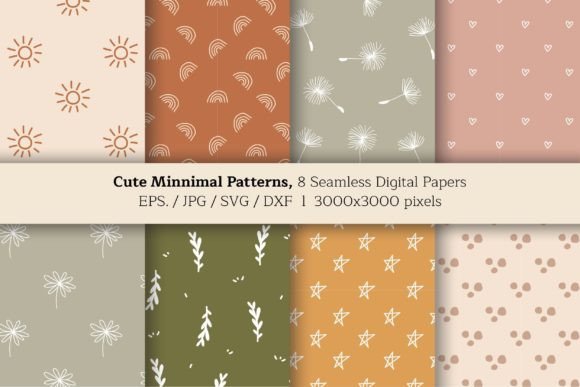
Imagine wrapping a birthday gift for your niece and realizing—mid-fold—that the paper feels *right*. Not flashy, not overwhelming, just soft, warm, and quietly joyful. That’s the quiet power of the Minimal Patterns Set: eight hand-crafted, seamless vector patterns built around simple hearts in an earthy two-tone palette—think terracotta and oat, sage and cream, or charcoal and clay. Designed as vector illustrations (EPS 10 + high-res JPG), each pattern is 3000 × 3000 px, fully scalable, and ready to drop into real projects without pixelation or compromise.
Why “minimal” isn’t just a style—it’s a practical choice
Minimal doesn’t mean “bare” or “basic.” In practice, it means clarity first. These heart-based patterns use clean lines, generous negative space, and intentional repetition—so they recede gracefully as backgrounds yet hold character when scaled up on a wall or down on a baby onesie. The two-tone earthy palette avoids synthetic brightness, making them easy on the eyes and versatile across seasons and settings. No neon pinks or electric blues—just grounded, breathable color that works with wood furniture, linen curtains, handmade ceramics, and sunlit classrooms.
Where these patterns live—and why they stick around
Designers don’t pick patterns in a vacuum. They choose based on what solves a problem *today*. Here’s where the Minimal Patterns Set fits naturally:
- Small-batch textile studios use the EPS files to tile directly into fabric printing workflows—no reworking needed. One maker told us she applied the lightest heart pattern to organic cotton muslin for baby swaddles; parents consistently comment on how “calm” and “soft-looking” the print feels—even before touching it.
- Independent stationery brands layer the patterns behind hand-lettered quotes or use them full-bleed on greeting cards. Because the repeat is truly seamless and the contrast gentle, text stays legible and the mood stays tender—not busy.
- Educators and therapists print the patterns on matte cardstock for sensory bins, emotion cards, or classroom borders. The heart motif reads clearly at small sizes, and the lack of visual noise helps neurodiverse learners stay focused—not distracted.
- Interior designers working with rental constraints apply the patterns as removable wallpaper or large-scale decals. One designer used the medium-density heart layout on a feature wall behind a toddler’s reading nook—rental-friendly, warm, and ageless enough to grow with the child.
Real use cases—beyond the obvious
It’s tempting to think of patterns only as “wallpaper” or “fabric.” But this set shines where subtlety matters most:
- Embroidery guides: Stitchers import the JPGs into apps like PatternLab or stitch by eye—the clean outlines and consistent spacing make tracing intuitive, even for beginners. A hobbyist recently shared how she enlarged one pattern to 4×4 inches, printed it on transfer paper, and stitched it onto denim backpacks for her kids’ first day of school.
- Digital learning assets: Teachers embed the patterns as subtle backgrounds in Google Slides or Canva templates—no competing with content, just adding warmth. One Montessori educator uses the lightest version as a calming backdrop for breathing exercise slides during transitions.
- Local craft fairs & Etsy listings: Sellers pair the patterns with natural materials—e.g., printing on kraft paper for eco-wrapping, then tying with jute twine. Customers notice the cohesion: earthy pattern + earthy packaging = intentional brand storytelling, no copy needed.
- Small-run Batik experiments: Because the vector outlines are crisp and uncluttered, they translate cleanly to wax-resist stencils. A textile artist in Asheville tested three patterns on silk scarves—each held detail through multiple dye dips, with zero bleeding at the heart edges.
What to consider before using—or buying—these patterns
Not every minimal pattern works everywhere. Before dropping one into your next project, ask yourself:
- What’s the scale? A dense heart repeat may feel cozy on a pillow but visually heavy on a 10-foot wall. The Minimal Patterns Set includes variations—from airy (2–3 hearts per tile) to rhythmic (6–8)—so match density to surface size and viewing distance.
- What’s the material? Vector EPS files give you full control for screen printing or laser engraving. But if you’re printing on textured paper or unbleached canvas, test a small swatch first—the earthy tones can shift slightly depending on absorbency and base color.
- Who’s experiencing it? For children’s textiles, avoid tiny details that could snag or fray. These patterns were designed with rounded corners and no micro-gaps—safe for embroidery, appliqué, and repeated washing.
- Is consistency part of your brand language? If you use this set across business cards, website headers, and product tags, the unified two-tone system creates instant recognition—no need for logos or slogans to signal cohesion.
How creators actually save time (and stress)
Freelancers often tell us their biggest bottleneck isn’t creativity—it’s *rework*. Sourcing, resizing, adjusting contrast, fixing tile seams, converting formats… all before the real design work begins. With the Minimal Patterns Set, that friction disappears. You get:
- Eight unique repeats—not just color swaps—so you’re not repeating the same rhythm across unrelated projects.
- True vector scalability: enlarge for a trade show banner or shrink for a logo watermark, with zero quality loss.
- No licensing surprises: use commercially, across unlimited products and platforms, no attribution required.
- Embroidery-ready line weights and spacing—no extra cleanup needed before digitizing.
One freelance surface pattern designer told us she cut her client revision cycle in half after switching from custom-drawn repeats to this set for initial mood boards. Clients responded faster to the *feeling*—not the technical execution—because the foundation was already calm, cohesive, and intentional.
A note on longevity
Trends fade. But thoughtful minimalism endures—not because it’s trendy, but because it meets people where they are: seeking calm in cluttered homes, authenticity in saturated feeds, warmth in mass-produced spaces. These heart patterns don’t shout. They nestle in. They support. They last through seasons, skill levels, and business pivots—whether you’re launching your first Etsy shop, designing a kindergarten curriculum, or refreshing your studio’s client presentation deck.
If you’ve ever paused mid-project, wondering whether a pattern *feels* like home—not just looks correct—you already know what this set offers. It’s not decoration. It’s quiet intention, made tangible.